
Merchant Cash Advance: How It Works
A merchant cash advance is cash today in exchange for a share of sales the business has not made yet. Owners look it up when a bank loan feels too slow or too strict. They need a straight answer on what the product is, what it costs, and who it fits. The short version: it uses a factor rate, it is repaid from future receipts, and it gets expensive fast if sales slow down.
What Is a Merchant Cash Advance?
The Consumer Financial Protection Bureau describes a typical merchant cash advance in its small-business lending rule FAQ. The business receives cash and promises to repay it plus an added multiple, often called a payback or factor rate. Examples the bureau uses are 1.2 and 1.5. Repayment is a percentage of future revenue, such as daily card receipts, or a fixed daily withdrawal until the agreed amount is paid. Collection often runs through the card processor or through ACH debits on the business bank account.
The CFPB groups this under sales-based financing. Funds go out now. Repayment is tied to anticipated sales, revenue, or invoices. The bureau also treats a typical advance as business credit for that rule, even when the contract is written as a sale of future receipts. You can read the definition in the CFPB small business lending rule FAQs.
That structure is why this is not a term loan, a line of credit, or a business bridge loan. A loan has a stated interest rate, a set number of payments, and a maturity date. An advance is a purchase of future receipts. On a true percentage deal, a slow month stretches the payoff instead of creating a missed installment. Read the agreement anyway. Some contracts switch to a fixed daily debit. Some add fees if receipts drop. Some require a personal guarantee. The label on the marketing page is not the contract.
ThinkBiz Capital Group helps owners compare financing through a lender network. The firm offers a consultation. It does not claim to be the funder of record on an advance. Whether an advance is one of the options a partner will offer depends on the business, not on a product page.
How Does a Merchant Cash Advance Work?
Three numbers decide the deal. You should be able to point to each one in the offer before you sign.
Advance amount. This is the cash deposited to the business. ThinkBiz advertises funding from $5,000 to $5 million across its lender network. That range is not an advance limit. It is not a promise that any one business will be approved for either end of it.
Factor rate. This is a multiplier such as 1.2 or 1.5, the examples the CFPB uses. Multiply the advance by the factor to get the total payback. A $40,000 advance at 1.3 means $52,000 goes back, no matter how many weeks that takes.
Holdback or retrieval. This is the share of each day's card sales, or the fixed daily ACH amount, sent to the provider until the payback is met. A 12 percent holdback on $3,000 of card sales is $360 that day. A fixed $400 daily debit does not shrink when sales do.
Speed is the reason owners take the product. Card processors already see the sales history, so some providers underwrite from deposits and statements instead of a full bank package. ThinkBiz's site says funding is often available within a few days. The homepage also says "same day business funding." Neither line is a deadline. The terms of service say outcomes, approvals, funding, and results are not guaranteed. Treat any timeline as something to confirm on the offer.
A factor rate is easy to misread as an interest rate. It is not an APR. The same 1.3 factor costs more as a yearly rate if the advance is paid off in three months than if it is paid off in nine. The dollars owed do not shrink when the calendar does. Ask the provider for the total dollars to be repaid. Ask for an estimated payoff window based on your recent sales. Then compare that dollar cost with a term loan or a line of credit. The advance is often the more expensive option.
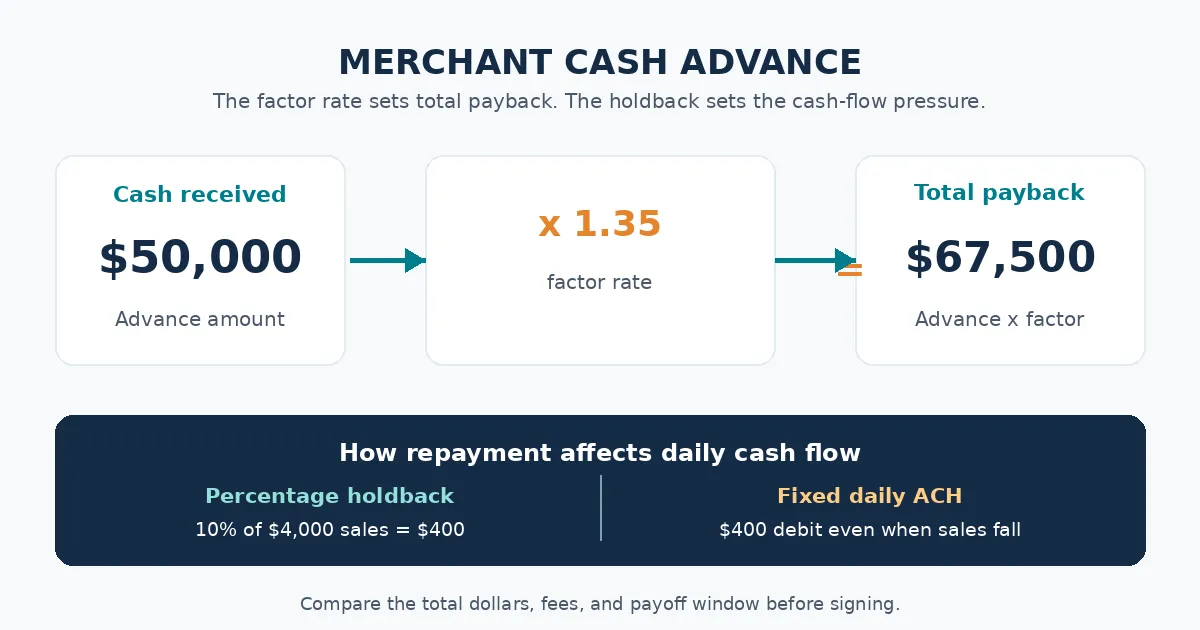
Walk a simple case. A restaurant takes a $50,000 advance at a 1.35 factor. Total payback is $67,500. Card sales average $4,000 a day, and the holdback is 10 percent, so about $400 leaves each day. At that pace the advance is gone in roughly 169 processing days, before closures and slow weeks. If January card sales fall by a third, a percentage holdback stretches the payoff. A fixed $400 ACH does not. It keeps pulling $400 on the quiet days. That is the number to stress-test, not the headline speed.
What Does a Merchant Cash Advance Cost?
The factor is the headline. Fees around it change the dollars you actually receive and the dollars you actually repay. Common add-ons, when a contract includes them, are an origination fee taken off the top, an ACH return fee, and a stack of extra costs if you pay the advance off early or default. None of these is a ThinkBiz price. The firm does not publish factor rates, fees, or a sample quote. They belong to the funding partner on a specific offer. Ask for them in writing before you compare the advance with anything else.
Factor rate. What multiple of the advance equals the total payback? This sets the dollars owed, separate from how long repayment takes.
Holdback style. Is retrieval a percent of sales or a fixed daily ACH? A fixed debit does not shrink when sales drop.
Fees. Which fees come out of the deposit, and which are charged later? A fee off the top means you receive less than the stated advance.
Payoff window. How many weeks would recent sales take to retire the payback? A short window makes the same factor much more expensive as a yearly rate.
Guarantee. Does an owner sign personally, and what triggers a default? A personal guarantee changes who is on the hook if receipts fall.
Do the yearly-rate check yourself so the factor cannot hide the cost. Dollars of payback above the advance, divided by the advance, divided by the fraction of a year you expect to carry it, is a rough annualized cost. On the restaurant case, $17,500 of cost on $50,000 over about 169 processing days is steep once you put it next to a term loan. It is not a formal APR, and it ignores fees. It is enough to stop a 1.35 factor from looking like "35 percent."
How Do Providers Evaluate a Merchant Cash Advance?
Underwriting follows the receipts, not a personal credit score. Providers typically want steady deposits, a real processing or bank history, and a balance that can absorb the daily retrieval. A business that takes most of its sales on cards is easier to underwrite than one that invoices net-30. The holdback can come out of the processor. Invoice-heavy firms are often a better fit for factoring or a line of credit. Those are different products.
ThinkBiz publishes a document list on its homepage. It is a document request, not a stated minimum time in business. Have these ready before you apply:
Four months of business bank statements.
A voided check from the business account.
A valid driver's license.
Proof of business ownership.
The site also says businesses with less-than-perfect credit may still qualify, because partners look more at the business than at personal credit. The word "may" is doing real work. It is not an approval standard. It does not name a minimum credit score, a minimum monthly revenue, or a list of excluded industries. ThinkBiz's intended clients are owners seeking expansion or cash-flow relief, including firms that take cards. Eligibility for an advance is set by the funding partner on that file.
Card-heavy businesses are the usual candidates. Restaurants, retailers, convenience stores, auto repair shops, salons, and fitness clubs all run a daily card batch. The industries ThinkBiz serves include those businesses alongside construction, healthcare, and professional services. A listing is an example of who the firm talks to. It is not proof that an advance provider will fund that sector or that use.
When Does a Merchant Cash Advance Fit?
An advance fits a narrow job. A card-processing business needs cash this week for inventory, a repair, payroll, or a short project. It can give up a slice of each day's receipts without starving operations. Size the holdback against a slow week, not a peak Saturday. If a 15 percent slowdown would make payroll miss, the retrieval rate is too high.
It is a weak fit when the need is long, large, or cheap. Buying equipment, consolidating old debt, or funding a build that will not produce sales for months usually belongs on a term structure. An SBA 7(a) loan is slower and stricter, and it is priced as a loan rather than a factor. A bridge loan covers a defined gap with a payoff date. A line of credit lets the business draw and repay. Those options live on the ThinkBiz services page next to working capital, equipment financing, and payroll capital. Merchant cash advances are not listed among ThinkBiz's public services. A consultation can help determine whether a funding partner offers a potentially suitable product. It is not the default.
Stacking a second advance on top of the first is the failure mode to avoid. Two holdbacks against the same card batch can take a third of daily sales before rent is paid. If an existing advance is still open, say so in the consultation. Hiding it does not make the second offer safer. A provider who will not fund you once they see the first advance is telling you something useful.
Use a short pause before you sign. Confirm the total payback in dollars. Confirm whether retrieval flexes with sales. Confirm that a slow month still covers payroll, rent, and suppliers after the holdback. If any of those answers is missing, you do not have an offer yet. You have a marketing page.
One more check belongs to the owner, not the provider. Write down a slow week from the last year and subtract the holdback from that week's deposits. What is left has to cover payroll, rent, food or inventory, and the loan payments you already have. If the remainder is negative, the advance is too big or the retrieval rate is too high. Shrinking the advance is often the better move. A smaller payback that the slow week can carry beats a larger deposit that only works in a good month.
Want a person to look at the receipts with you? Call (949) 990-5443 for a complimentary consultation, or send a note through the contact page.
FAQ
Is a merchant cash advance a loan?
Providers usually write it as a sale of future receipts, not as a loan with interest and a maturity date. The CFPB still treats a typical advance as business credit for its small-business lending rule. Read the contract for a fixed daily debit, fees, or a personal guarantee. Those terms matter more than the product name.
How is the cost quoted?
Cost is a factor rate times the advance, plus any fees in the agreement. A 1.4 factor on $25,000 means $35,000 paid back. That is not an APR. Ask for the total dollars due and how long similar deposits would take to retire it. ThinkBiz does not publish factor rates. The number comes from the funding partner on a specific offer.
What happens if sales drop?
On a true percentage holdback, a slow week sends less money and the payoff takes longer. On a fixed daily ACH, the debit stays the same and can overdraw the account. Confirm which one the offer uses, and what fees apply if a debit returns.
What should I send ThinkBiz?
The homepage asks for four months of business bank statements, a voided business check, a driver's license, and proof of ownership. A partner may also ask for card-processing statements. Sending documents is not an approval.
Will I be approved if my credit is weak?
ThinkBiz says less-than-perfect credit may still qualify because partners weigh the business. That is not a guarantee. Approvals, amounts, and timing are not promised in the terms of service.
